Part 1: Is an Undefined Scope Putting Your Project at Risk?
Selecting the right CDMO is one of the most important decisions in drug development. Yet even experienced biotechs and pharma companies can find themselves trapped in projects where the initial excitement gives way to frustration, and one of the most common culprits is a poorly defined scope.
The Problem: “We’ll Figure It Out Later”
At first glance, a proposal can look detailed and impressive. The project plan lists deliverables, milestones, and timelines. But once the work begins, the gaps start to show. Analytical methods are mentioned, but no one has defined what “ready” means. Process development starts, but there is no shared understanding of what success looks like. Formulation studies begin without knowing what regulatory question they are meant to answer.
This lack of definition often gets mistaken for flexibility. Teams convince themselves that details can be refined later, once the data starts coming in. But in practice, that “we’ll figure it out later” mindset creates uncertainty at every step. When objectives are not clearly tied to measurable outcomes, projects start to lose focus; experiments are repeated, priorities shift, and teams waste valuable time resolving avoidable misalignments.
For example, a development program might agree to “optimize a process” without defining the target yield or impurity threshold. Weeks of work can pass before both sides realise they had different interpretations of success. By that point, resources and material have already been spent.
In drug development, this type of misalignment can be costly. Every data point, method, and experiment feeds into a future submission. If those activities don’t align with regulatory expectations, results may need to be repeated — turning what felt like efficiency into lost time, higher costs, and unnecessary frustration.
The reality is that structure doesn’t slow science down; it protects it. Clarity at the start saves time later, prevents rework, and helps every person involved stay focused on the same outcome.
Why It Matters
An unclear or constantly changing project plan doesn’t just affect budgets; it affects trust. When there are no shared success measures, teams start working toward different interpretations of “done.” Meetings become about resolving misunderstandings or renegotiating priorities rather than advancing the science.
For small and mid-sized biotech companies, the impact can be especially significant. Each milestone often connects directly to funding rounds or investor confidence, so even small delays can ripple across an entire program.
Clarity is not just about timelines or efficiency, it is about protecting relationships, resources, and momentum during the most critical stages of development.
How to Spot It Early
Before committing to a new CDMO partnership, take a close look at how clearly the proposal defines success. Some red flags are easy to miss at first glance but can reveal a lack of structure beneath the surface.
Watch out for:
- Vague success language: Terms like “robust process development” sound reassuring but mean little without measurable criteria such as yield, purity, or reproducibility targets.
- Overly linear timelines: Development rarely moves in a straight line. If there is no allowance for iteration or troubleshooting, the plan may be unrealistic.
- No discussion of risk: Every program faces uncertainty around solubility, stability, or scalability. If the proposal does not mention how these will be managed, that is a warning sign.
These are not small oversights. They suggest that the CDMO is planning for best-case outcomes rather than preparing for real-world challenges — and that is often where projects start to drift.
How to Prevent It
The best safeguard against shifting scope is structure. Clarity protects both the science and the relationship.
Start by:
- Defining a detailed Statement of Work (SoW): Include clear milestones, measurable deliverables, and agreed success criteria so everyone knows what progress looks like.
- Setting readiness metrics early: Establish what IND/IMPD readiness means for your specific program before any lab work begins.
- Building in escalation points: Proactively plan for “what if” scenarios, such as a drop in yield or a formulation that fails stability, so there is a defined path forward when challenges arise – because experience shows that they will.
Experienced CDMOs welcome this level of structure. It gives both sides confidence, strengthens accountability, and encourages the kind of open, consistent communication that keeps everyone aligned. When expectations are clear from the start, the plan feels less like a set of assumptions and more like a roadmap everyone can follow together with clarity and ease.
Our Perspective
At Exemplify BioPharma, a Symeres company, we’ve seen what a difference early clarity can make. When project goals and expectations are defined together, everyone works with purpose. Communication improves, decisions come faster, and challenges are easier to solve before they grow.
What sets us apart is how closely our teams collaborate. Our chemists, analysts, formulators, and regulatory experts work side by side to define success from the start and adjust course as new data emerge. It’s not just about delivering results, it’s about building understanding, alignment, and trust along the way.
Drug development will always involve unknowns, but the path becomes far smoother when everyone shares the same vision. We know that through clear planning and open communication we give our partners the confidence to keep moving forward, one milestone at a time.
Next in the Series: Underestimating Technology Transfer Complexity – Why “Scale-Up” Isn’t Just a Bigger Batch.
If you’d like to explore all five red flags in depth, fill out the form to view our full whitepaper: 5 CDMO Red Flags You Can’t Ignore: A Guide for Biotechs and Pharma
Gated content
Experience a deeper understanding of this content by completing the form below.
Resources we think you'll love
Blog
When slowing chemistry speeds programs up
Blog
When a clean PK profile is actually a warning sign
Blog
CDMO red flags you can’t ignore: Communication breakdowns
Blog

CDMO red flags you can’t ignore: Capacity constraints and resource stretch
Blog

CDMO red flags you can’t ignore: Regulatory shortfalls and misalignment
Whitepaper
5 CDMO red flags you can’t ignore: A guide for biotechs and pharma
Blog

CDMO red flags you can’t ignore: Underestimating technology transfer complexity
Blog

O.N.E Symeres: A practical approach to real-world drug development
Whitepaper
Accelerating chemical innovation: Unveiling Symeres’ parallel chemistry
Webinar | On-demand

From racemic to pure the art and science of enantiomer separation
Whitepaper
IND & IMPD enabling developability roadmap
Whitepaper

Innovations in unnatural amino acids: Advancing functional diversity and applications
Whitepaper
Leveraging copper-catalyzed ullmann-type cross-coupling reactions in PR&D
Whitepaper

Managing nitrosamines in the pharmaceutical industry: A comprehensive approach
Whitepaper
Optimizing solid-state properties and enhancing API bioavailability through physicochemical prediction
Whitepaper

Stable isotope-labeled compounds
Whitepaper
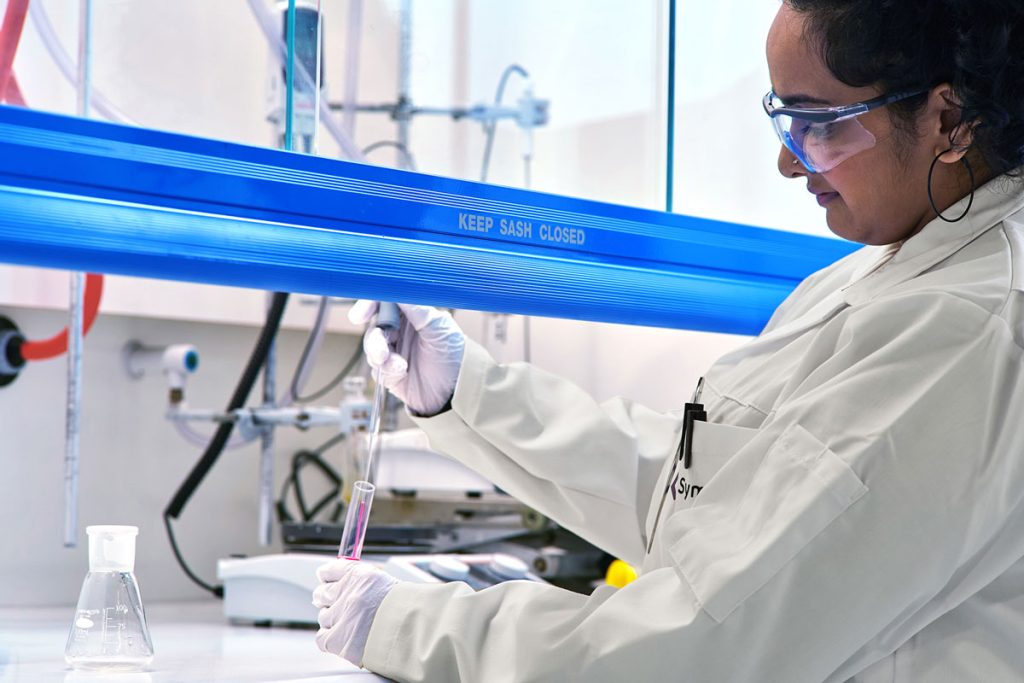
Unlocking the potential of high-throughput screening: Symegold library design and expansion insights
Interviews
Insights into drug discovery and development 2025
Interviews
Interview with the computer-aided drug design (CADD) department
Interviews

Meet the Organix Director, Mario Gonzalez
Interviews

Interview with the new Managing Director of Symeres Groningen
Interviews
An interview with Yadan Chen and Paul O’Shea
Interviews

An interview with Anu Mahadevan and Paul Blundell
Blog
Crystalline and liquid crystalline 25-hydroxy-cholest-5-en-3-sulfate sodium and methods for preparing same
Webinar | On-demand
In vivo pharmacokinetic experiments in preclinical drug development
Webinar | On-demand
Accelerating medicinal chemistry by rapid analoging
Webinar | On-demand
Solid-state chemistry part II: Optimal form selection by controlled crystallization
Webinar | On-demand
Route scouting for kilogram-scale manufacturing of APIs
Webinar | On-demand
Solid-state chemistry part I: Introduction

Speak with our experts
Let’s discuss how Symeres can support the discovery and development of your next breakthrough