A client needed a route to the (S)-enantiomer of their inhibitor, AAT-076, that delivered at least 60% yield, over 98% enantiomeric excess (ee), high chemical purity, and preferably no recrystallization. The route developed was a crystallization-induced diastereomeric transformation (CIDT) – classical resolution paired with in situ (photochemical) racemization – built from two parallel screens and one careful compatibility decision.
AskAt’s specifications
AAT-076 is the (S)-enantiomer of a cyclooxygenase-2 (COX-2) inhibitor under development at AskAt for joint pain and inflammation, while the (R)-enantiomer is known to be inactive. AskAt’s specification was tight: enantiomeric excess above 98%, yield above 60%, and the route had to run via diastereomeric salt formation with in situ racemization. That last clause rules out the simpler options, since a classical resolution is diastereomeric salt formation without racemization, separated by solubility difference. It requires an acidic or basic group, has a 50% theoretical maximum yield, but typically gives 40–45% in practice.
The brief therefore narrowed the route to CIDT. What was left to decide was the resolving agent, the racemization handle, and whether the two were compatible under the same process conditions.
Why CIDT and why it isn’t DKR
The CIDT cycle couples two reactions running in different phases. In the solid phase, the desired (S)-acid forms a less-soluble diastereomeric salt with a chiral amine and precipitates. In the liquid phase, racemization continuously converts unreacted substrate back to racemate, so the (R)-acid, which would otherwise sit in solution as waste, is recycled into the equilibrium where the formed (S)-salt accumulates as solid leaving a racemic solution and a nearly enantiomerically pure precipitate. Theoretical yield,100%. Practical yield on AAT-076, 85%.
CIDT is often confused with dynamic kinetic resolution (DKR). The selectivity is thermodynamic, not kinetic. DKR depends on a catalyst making a kinetic discrimination between two enantiomers of substrate; CIDT depends on a solubility difference between two diastereomeric salts, combined with reversible racemization. The distinction matters because the screening burden differs: DKR optimizes catalyst and conditions, while CIDT optimizes resolving agent, solvent, and racemization handle as a coupled system.
Screening and where the work happened
Screening here is absolutely essential, since many diastereomeric salts formed from the same racemate have similar solubility, end-solid solution behavior can force multiple recrystallizations and lower yield, and solvent choice matters because solvates/hydrates can change solubility.
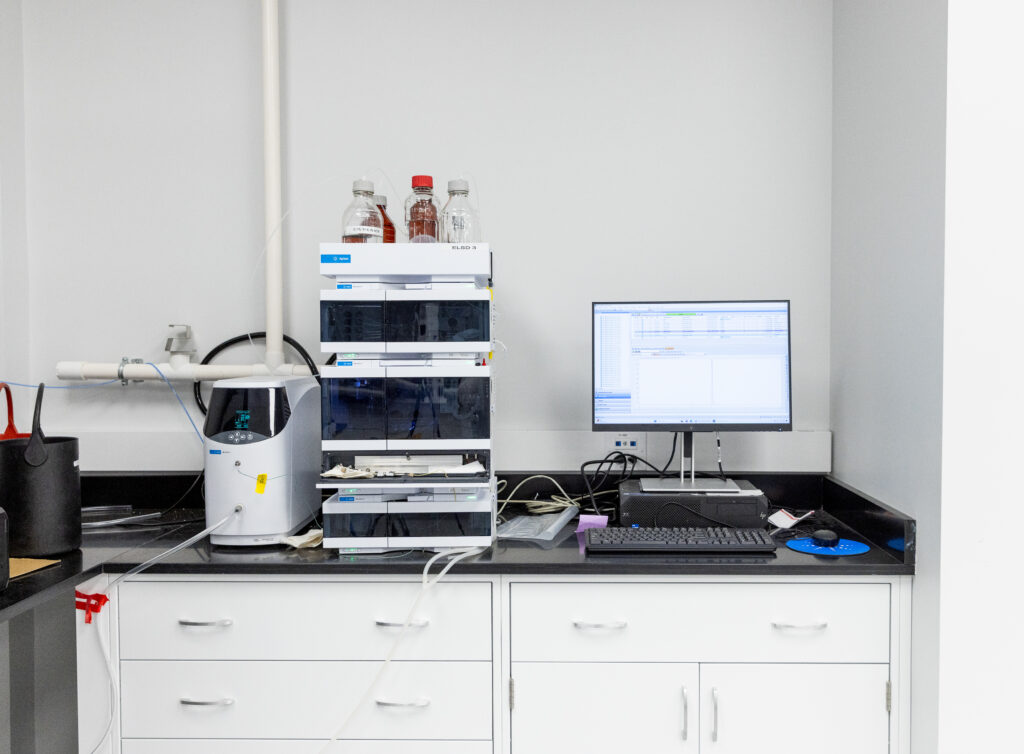
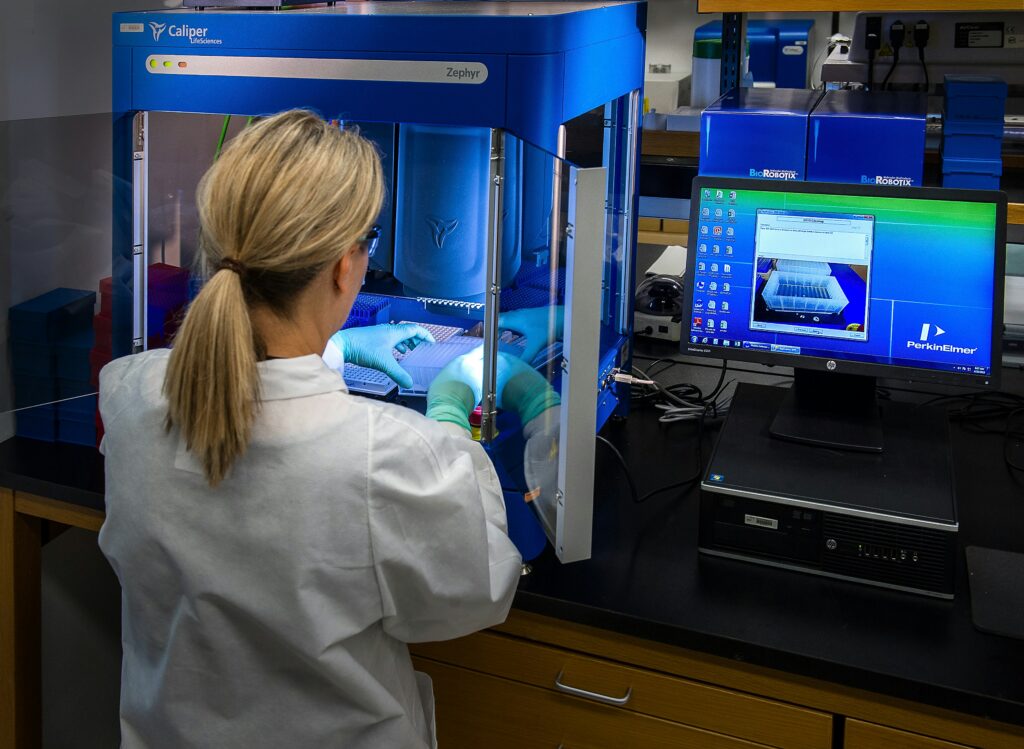
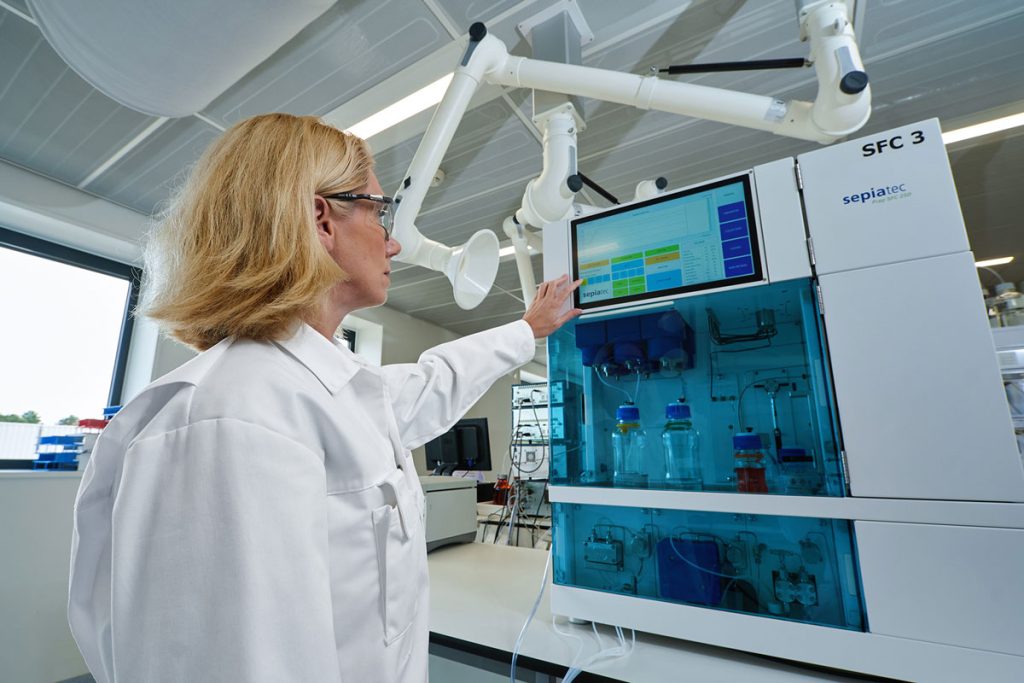
In Symeres’ standard resolution workflow, screens can cover 80 basic or acidic resolving agents across 12 solvents at 15 µmol scale, giving 960 experiments. In the AskAt program, that screening returned six resolution hits.
Racemization screening tested basic, acidic, and photochemical conditions. UV-A at 370 nm, from an LED source, gave the cleanest racemization profile and the (R)-acid was converted back to racemate without measurable side-product formation in the solvent windows that mattered.
L-phenylalaninol in acetonitrile under 370 nm LED irradiation won on three grounds: the cleanest resolution profile of the six hits, full compatibility with the photochemical racemization conditions, and the lowest cost. L-phenylalaninol is currently around $350 for a kilogram, with one kilogram of resolving agent enough to process 2.2 kg of racemate. Moreover, L-phenylalaninol can be liberated from the salt to be re-used in the next CIDT.
Without 960 experiments behind it, picking L-phenylalaninol under 370 nm UV-A would have been a guess.
The result
Every target was cleared with margin. Enantiomeric excess landed at 99.0% (S), one percentage point above the >98% specification. Yield came in at 85% – 25 percentage points above the >60% brief, and 40 to 45 percentage points above where a non-dynamic classical resolution would have stopped. Chemical purity exceeded 99.7% and no recrystallization was required.
This work led to above-spec purity without a recrystallization step that meant the (S)-salt left the CIDT vessel ready for downstream processing. There were fewer unit operations, less solvent consumption per kilogram of isolated salt, and a shorter analytical narrative for the regulatory file. The 80% yield also means the unwanted enantiomer was being converted back to substrate inside the same flask, rather than being discarded.
When CIDT is the right call, and when it isn’t
CIDT works when three conditions hold together. The substrate has to carry an accessible acidic or basic functional group that can form a diastereomeric salt with at least one screened resolving agent. A racemization pathway – chemical or photochemical – must run cleanly under the same conditions as the salt formation. And the target needs to be a single-enantiomer API at a scale where the yield gain justifies the screening burden up front.
However, in other cases, CIDT is the wrong call, such as when there is no accessible racemization pathway and classical resolution caps out at 50%, or when functional groups fail to form stable salts with any screened resolving agent. For conglomerate racemates, preferential crystallization or crystallization-induced enantiomeric transformation (CIET), including Viedma ripening and temperature cycling, may instead provide a route that avoids resolving-agent costs entirely.
A chemist reading this with their own molecule in mind would be able to tell, before contacting Symeres, whether CIDT is worth screening for the substrate in front of them. If it is, the work that follows (i.e. resolution screen, a racemization screen, and one coupling decision) is the same work that took AAT-076 from a 50% ceiling to 85% in the flask.
Resources we think you'll love
Webinar | On-demand
DILI Uncovered: how to mitigate hepatoxicity failure
Webinar | On-demand
The Greatest Hits: A beginner’s guide to high-quality starting points for Drug Discovery
Blog
ADME-Tox testing in drug discovery: your questions answered
Webinar | On-demand
Embracing scientific complexity to mitigate toxicity issues and development risks while advancing toward the clinic
Infographics
Map your molecule’s next move with the Symeres developability roadmap
Blog
Three Signs Your Synthetic Route Will Collapse at Scale
Blog
Lead optimization: what data actually drive decisions?
Blog
When slowing chemistry speeds programs up
Blog
When a clean PK profile is actually a warning sign
Blog
CDMO red flags you can’t ignore: Communication breakdowns
Blog

CDMO red flags you can’t ignore: Capacity constraints and resource stretch
Blog
CDMO red flags you can’t ignore: Regulatory shortfalls and misalignment
Whitepaper
5 CDMO red flags you can’t ignore: A guide for biotechs and pharma
Blog
CDMO red flags you can’t ignore: Underestimating technology transfer complexity
Blog
O.N.E Symeres: A practical approach to real-world drug development
Blog
CDMO red flags you can’t ignore: Undefined or shifting project scope
Whitepaper
Accelerating chemical innovation: Unveiling Symeres’ parallel chemistry
Webinar | On-demand

From racemic to pure the art and science of enantiomer separation
Whitepaper
IND & IMPD enabling developability roadmap
Whitepaper
Innovations in unnatural amino acids: Advancing functional diversity and applications
Whitepaper
Leveraging copper-catalyzed ullmann-type cross-coupling reactions in PR&D
Whitepaper
Managing nitrosamines in the pharmaceutical industry: A comprehensive approach
Whitepaper
Optimizing solid-state properties and enhancing API bioavailability through physicochemical prediction
Whitepaper

Stable isotope-labeled compounds
Whitepaper
Unlocking the potential of high-throughput screening: Symegold library design and expansion insights
Interviews
Insights into drug discovery and development 2025
Interviews
Interview with the computer-aided drug design (CADD) department
Interviews

Meet the Organix Director, Mario Gonzalez
Interviews

Interview with the new Managing Director of Symeres Groningen
Interviews
An interview with Yadan Chen and Paul O’Shea
Interviews

An interview with Anu Mahadevan and Paul Blundell
Blog
Crystalline and liquid crystalline 25-hydroxy-cholest-5-en-3-sulfate sodium and methods for preparing same
Webinar | On-demand
In vivo pharmacokinetic experiments in preclinical drug development
Webinar | On-demand
Accelerating medicinal chemistry by rapid analoging
Webinar | On-demand
Solid-state chemistry part II: Optimal form selection by controlled crystallization
Webinar | On-demand
Route scouting for kilogram-scale manufacturing of APIs
Webinar | On-demand
Solid-state chemistry part I: Introduction

Speak with our experts
Let’s discuss how Symeres can support the discovery and development of your next breakthrough