The ‘Computer-Aided Drug Design’ Department provides computational design support for our clients’ drug discovery projects. In this interview, we introduce our CADD experts and see what exciting developments are awaiting us this year.
Can you introduce yourselves?
Eddy Damen did his PhD in Nijmegen and started as an organic chemist in Nijmegen 24 years ago. After being involved in building the Parallel Chemistry Department in the early 2000s, Eddy changed departments in around 2012, when Mercachem began offering medicinal chemistry services, including computational chemistry. Eddy started CADD support by learning on the job.
In 2021, Giovanni Bolcato joined the team. He studied medicinal chemistry and pharmaceutical technologies and did his PhD in pharmaceutical sciences, working in the field of computational chemistry. He worked with a group in Sweden, on a project about the application and development of artificial intelligence (AI) methods in drug discovery before joining Symeres.
Can you explain what the CADD Department does?
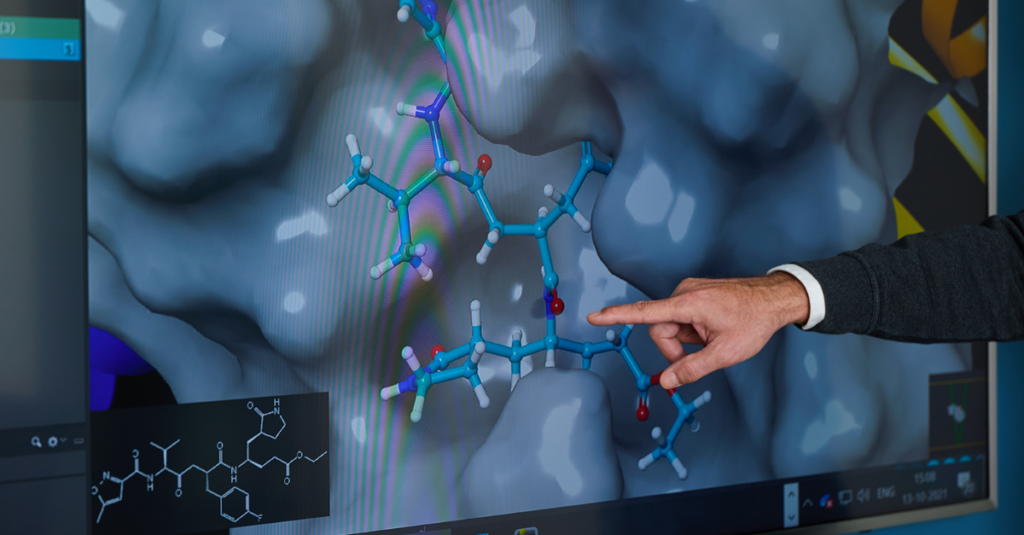
CADD can be divided into ligand- and structure-based methods. Structure-based design, where you design your compounds based on a protein or receptor you’re targeting, makes up the vast majority of daily work, since nowadays more and more 3D structural data, like crystal structures and (AI-derived) homology models, are available. With this structural information, the computer can help to find potentially active compounds. Often, the team members design and propose compounds that can be judged and prioritized by computational methods. Eddy commented: “CADD at Symeres is mainly about generating ideas and understanding which ideas will take the project in which direction.”
What software do you use?
At the moment, the CADD Department uses the software suites MOE, from the Chemical Computing Group, and Maestro, from Schrödinger. Furthermore, they have access to Spark (Cresset), which has been quite successful in several projects where scaffold hopping was requested. Finally, LiveDesign™ (Schrödinger) can be used to share project data and computational models. In this web-based application running from the Amazon cloud, users can, for example, dock their design ideas. Several team leaders of medicinal chemistry and one customer have access to LiveDesign™, facilitating design sessions by sharing ideas.
Can you highlight some of your recent work?
Next to assisting in a dozen projects using different computational approaches, the CADD team offers virtual screening. In virtual screening, a range of chemical structures are tested on the computer model of the intended target to see which structures theoretically would bind to the target. If this is done well, it can greatly reduce the number of compounds that need to be screened through an actual biochemical assay, saving the customer both time and money. For this, a complete workflow has been established, from selection and preparation of a database to screening and nomination of the final hits. At Symeres, virtual screening can be performed using either a database of 8.8 million stock compounds from a commercial supplier, the Symegold library (75,000 compounds) available at Axxam for high-throughput screening, or the Symeres Virtual Library. At the moment, this last library contains about 17 million compounds derived from unique scaffolds, which have been validated for library synthesis. Also, a diverse subset of the Enamine REAL™ library (31 million compounds) has been prepared and can be used off the shelf in virtual screening.
Both computational chemists emphasize that the virtual screening offered at Symeres is unique compared to the virtual screening at many other companies. “While most companies only return hits based on a particular scoring and ranking in silico, we at Symeres integrate a substantial amount of human intelligence, i.e., the outstanding knowledge of both our medicinal and synthetic chemists.”
Another recent highlight is the introduction of free-energy perturbation (FEP+). FEP+ is a computational method based on thermodynamics to calculate and predict the relative binding free energy of a ligand in a receptor. These calculations are computationally very demanding and have to be performed on a cluster of GPUs. When applied in the right way, FEP+ can positively contribute to lead-optimization projects by prioritizing compounds for syntheses.
Lately, a lot has been written about AI in different stages of medicinal chemistry projects. What is your opinion of AI and what are your future expectations?
Although worldwide billions and billions of dollars have been invested in AI, Giovanni and Eddy predict that eventually only a few companies introducing outstanding techniques will survive. “AI is dependent on ‘big data’ and performs best when the algorithms and models are fed with a very large amount of high-quality data,” says Giovanni. “However, this kind of data is only sporadically available in the public domain.”
Eddy adds, “This lack of data is especially true for compounds that enter clinical trials, and those compounds are the ones AI could learn the most from.” Nevertheless, machine learning will have its place in the toolbox and the next five years will be critical for its true value to be demonstrated.
We would like to thank Eddy and Giovanni for their contribution to this article. If you want to receive updates on their progress in 2024, follow us on LinkedIn.
Please contact us via our contact form if you have a project that would benefit from these solutions.
Resources we think you'll love
Infographics
Map your molecule’s next move with the Symeres developability roadmap
Blog
Three Signs Your Synthetic Route Will Collapse at Scale
Blog
Lead optimization: what data actually drive decisions?
Blog
When slowing chemistry speeds programs up
Blog
When a clean PK profile is actually a warning sign
Blog
CDMO red flags you can’t ignore: Communication breakdowns
Blog

CDMO red flags you can’t ignore: Capacity constraints and resource stretch
Blog
CDMO red flags you can’t ignore: Regulatory shortfalls and misalignment
Whitepaper
5 CDMO red flags you can’t ignore: A guide for biotechs and pharma
Blog
CDMO red flags you can’t ignore: Underestimating technology transfer complexity
Blog
O.N.E Symeres: A practical approach to real-world drug development
Blog
CDMO red flags you can’t ignore: Undefined or shifting project scope
Whitepaper
Accelerating chemical innovation: Unveiling Symeres’ parallel chemistry
Webinar | On-demand

From racemic to pure the art and science of enantiomer separation
Whitepaper
IND & IMPD enabling developability roadmap
Whitepaper
Innovations in unnatural amino acids: Advancing functional diversity and applications
Whitepaper
Leveraging copper-catalyzed ullmann-type cross-coupling reactions in PR&D
Whitepaper
Managing nitrosamines in the pharmaceutical industry: A comprehensive approach
Whitepaper
Optimizing solid-state properties and enhancing API bioavailability through physicochemical prediction
Whitepaper

Stable isotope-labeled compounds
Whitepaper
Unlocking the potential of high-throughput screening: Symegold library design and expansion insights
Interviews
Insights into drug discovery and development 2025
Interviews

Meet the Organix Director, Mario Gonzalez
Interviews

Interview with the new Managing Director of Symeres Groningen
Interviews
An interview with Yadan Chen and Paul O’Shea
Interviews
An interview with Anu Mahadevan and Paul Blundell
Blog
Crystalline and liquid crystalline 25-hydroxy-cholest-5-en-3-sulfate sodium and methods for preparing same
Webinar | On-demand
In vivo pharmacokinetic experiments in preclinical drug development
Webinar | On-demand
Accelerating medicinal chemistry by rapid analoging
Webinar | On-demand
Solid-state chemistry part II: Optimal form selection by controlled crystallization
Webinar | On-demand
Route scouting for kilogram-scale manufacturing of APIs
Webinar | On-demand
Solid-state chemistry part I: Introduction

Speak with our experts
Let’s discuss how Symeres can support the discovery and development of your next breakthrough