Home / Success stories / 400 oxalamides down to one HBV preclinical candidate, AIC263282
400 oxalamides down to one HBV preclinical candidate, AIC263282
A lead compound with 97% oral bioavailability, but no dose linearity, started a successful lead optimization program.
The program
AiCuris, now part of Veloxis Pharmaceuticals, was spun out of Bayer HealthCare’s anti-infectives division in 2006 and works on antiviral therapies for patients with weakened immune systems. Its hepatitis B (HBV) program targets a gap that current therapy does not close. WHO estimated 254 million people living with chronic hepatitis B in 2022, with 1.2 million new infections that year and 1.1 million deaths, mostly from cirrhosis and hepatocellular carcinoma (1).
Polymerase inhibitors such as entecavir and tenofovir suppress viral replication effectively. They have no effect on incoming virus, none on pregenomic RNA (pgRNA) or covalently closed circular DNA (cccDNA), and they do not eliminate infection, so low-level replication keeps the recycling pathway running and treatment continues for life.
Capsid assembly modulators (CAMs) act at most stages of the replication cycle. These compounds accelerate or misdirect capsid formation. Class I CAMs drive core dimers into aberrant aggregates, while class II CAMs speed up normal nucleocapsid assembly but produce empty particles that carry no pgRNA-polymerase complex, and both routes yield non-infectious virions. Several CAMs have reached the clinic without reaching the market, and the most advanced compound, ALG-000184, is a phosphate ester prodrug of a potent but poorly soluble parent (2). AiCuris set out to find a CAM that did not need a prodrug.
The constraint the program was actually solving
A virtual screen against HBV capsid X-ray structure 4G93 returned indole carboxamides, and a fingerprint similarity search around those hits produced a piperazine oxalamide library. That gave lead compound 1: EC50 53 nM in HepAD38, CC50 above 10,000 nM, 97% oral bioavailability in mice at 3 mg/kg. Low-dose (3 mg/kg po) pharmacokinetic studies in mice and rats had favorable profiles, but the dose escalation study to 30 mg/kg exposure did not increase.
The cause was kinetic solubility of 6 µM. Beyond a low dose, the compound could not get into solution to be absorbed, so the favorable low-dose PK profile carried no information about what would happen at therapeutic exposure. The optimization goals were to achieve kinetic solubility ≥50 µM and EC50 ≤10 nM, with in vitro clearance held at or below 50% of liver blood flow across species. Docking of 1 against an unpublished X-ray structure indicated the oxalamide as the region where physicochemical properties could be moved without losing the binding interactions, which are anchored by four hydrogen bonds at the HBcAg dimer-dimer interface.
Three regions and one problem
Oxalamide SAR. Switching to the 5,6-difluoro indole gave compound 2, less potent than 1 but more soluble, and that became the platform for oxalamide variation. Across the set, potency spanned below 1 nM to above 240 nM. Removing the stereocenter for a carbocycle raised potency without costing solubility. Oxetane 6 reached ≥100 µM kinetic solubility; replacing its oxygen with a sulfone dropped potency to 240 nM. Heteroaromatic replacements split the difference: triazole 10 was stable and soluble but weak, oxadiazole 11 restored potency at 13 nM and 68 µM solubility, and the meta- and para-pyridines 13 and 14 were potent and effectively insoluble at under 5 µM and 7.7 µM.
Indole SAR. The unsubstituted indole 16 lost potency by roughly a factor of ten against the disubstituted series. Lipophilic substitution at two positions was the requirement; a third fluorine added nothing. The 4-ethyl-6-fluoro pattern in 21 reached 10 nM while holding 61 µM solubility, which was the surprise of that round, since replacing fluorine with an aliphatic group would ordinarily be expected to cost solubility.
Piperazine SAR. One position was examined: methylation of the carbon adjacent to the nitrogen carrying the indole carboxamide. The (R)-enantiomer 27 was four-fold more potent than its unsubstituted analogue; the (S)-enantiomer lost two-fold. The aliphatic carbon introduced a metabolic soft spot, raising predicted clearance.
The final round combined all three regions, and more than 400 oxalamides were prepared across the campaign. Oxetanes were preferred over other heteroatom-containing spiro systems, fluorines raised potency, piperazine methylation helped, and several heterocyclic variants showed efflux.
hERG, and why potency was the key
Lead 1 showed no relevant hERG effect, with IC50 above 50 µM. That result was not reassuring, because 1 was barely soluble and the assay was reading a compound that could not reach high free concentrations. Once solubility improved, hERG appeared: 5 and 11 inhibited at 7.5 µM and 11 µM, giving margins over the HBV EC50 of 765- and 846-fold against a 1,000-fold target.
Rather than redesign against hERG directly, the team applied the potency-improving motifs already identified in the SAR, on the reasoning that hERG IC50 would stay roughly constant while EC50 fell. Compound 29 did not improve the margin, but compound 30 did, at 6.2 nM potency against a slightly higher hERG IC50 of 23 µM.
AIC263282
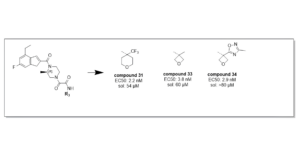
Figure 1. 4-Ethyl-6-fluoro analogs.
Compound 33 (Figure 1) carried the 4-ethyl-6-fluoro indole, the (R)-methyl piperazine, and a 3-methyloxetan-3-yl amide
Comparator 21 reached the same target profile on potency and solubility but carried a 1,899-fold hERG margin, MW 519 with one Ro5 violation, and 42% bioavailability. 33 was deemed the most balanced compound and became preclinical candidate AIC263282 Table 1 (3).
Table 1. Parameters pertaining to 4-ethyl-6-fluoro carboxamide, compound 33.
| Parameter | Value |
| EC50 (HepAD38, HBV DNA) | 3.8 nM |
| Kinetic solubility | 60 µM |
| hERG IC50 / margin over EC50 | 61 µM / 16,053-fold |
| Caco-2 A2B (efflux ratio) | 33 × 10-6 cm/s (1.8) |
| Predicted clearance, human / mouse / rat liver microsomes | 16% / 39% / 11% LBF |
| MW, clogP, tPSA, Ro5 violations | 430, 1.5, 95, 0 |
| Mouse PK: CL, Vss, t½, F% | 25 mL/min·kg (28% LBF), 1.3 L/kg, 0.57 h, 92% |
The rat dose escalation is the result that closes the loop on lead 1. A ten-fold dose increase from 3 to 30 mg/kg produced a roughly fifteen-fold rise in both AUC and Cmax, from 683 to 10,317 h·ng/mL and from 0.68 to 10 µM. The exposure ceiling that stopped 1 was gone.
Data beyond the paper
The recent paper on this work (3) reports HepAD38 potency and defers the primary hepatocyte work, but our own work shows it (Table 2). Across four cell systems, AIC263282 gave EC50 values of 3.8 nM (HepAD38), 4.6 nM (HepG2.2.15), 5 nM (HepG2-NTCP infection model) and 8 and 35 nM in primary human hepatocytes from two donors. HBsAg fell with an EC50 of 113 nM and cccDNA with 190 and 173 nM by Southern blot after Hirt extraction (Figure 2).
In that assay, entecavir produced no reduction in cccDNA at any concentration tested, and AIC263282 produced a dose-dependent one. Entecavir is doing what a polymerase inhibitor does, and the difference is the mechanistic case for the class.
Table 2. Primary human hepatocytes and hepatocyte-derived cell linesAIC263282.
| Cell type | Description | Marker | EC50 (nM) |
| HepAD38 | HBV expression | HBV DNA | 3.8 |
| HepG2.2.15 | HBV expression | HBV DNA | 4.6 |
| HepG2-NTCP | HBV infection | HBV DNA | 5 |
| PHH | HBV infection | HBV DNA | 8, 35a |
| HBsAg | 113 | ||
| cccDNAb | 190, 173a |
aData obtained from different PHH donors; bSouthern blot analysis after Hirt extraction
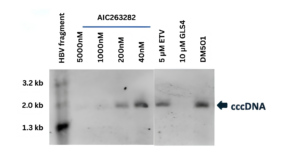
Figure 2. HBV cccDNA Southern blotting. PHHs were infected with HBV and treated with AIC263282. Hirt extracted and EcoRI linearized DNA were subjected to agarose gel electrophoresis and Southern blotting to detect HBV cccDNA with an HBV-specific probe. Controls: ETV, entecavir, CAM GLS4.
Open questions
Three limitations are wort noting. The CAM class of 33 was not determined but it is presumed to be class II CAM because lead 1 was demonstrated to act that way. Oxetanes have been associated with instability under acidic conditions and with hydrolysis by epoxide hydrolases, which the authors flag for compound profiling rather than resolve. And rat clearance came in at 31 mL/min·kg, 56% of liver blood flow, well above the 11% predicted from rat microsomes, with a short half-life; the more-than-proportional exposure increase at 30 mg/kg suggests a second clearance mechanism that saturates at higher doses.
The synthetic position is similar. Three routes were used, differing in the order of protection, deprotection and coupling. Methods 1 and 2 are five-step linear sequences that diversify the indole or the oxalamide in the final step, which is what a research program needs. Method 3 is convergent, with three steps in the longest linear sequence, but the potassium salt intermediate came through at 15%. Before any scale-up campaign, that route needs work.
Symeres’ role
Four Symeres scientists are co-authors on the paper (Arjen Cnossen, Wessel Sinnige, Jack Slootweg, Anita Wegert, all Nijmegen), and nineteen Symeres scientists were on the program. AiCuris ran the biology and ADME in house at Wuppertal, while synthetic and medicinal chemistry, idea generation and SAR interpretation was a team effort between between Symeres and AiCuris.
References
1. Hepatitis B, World Health Organization. https://www.who.int/en/news-room/fact-sheets/detail/hepatitis-b.
2. L. M. Blatt, “Long-term Dosing with ALG-000184 in HBeAg Positive Subjects Results in Unprecedented Multi-log Reductions in HBV Markers Including HBsAg” (2023); https://www.aligos.com/wp-content/uploads/2023/12/Aligos-CHB-HEP-DART-2023_FINAL.pdf.
3. B. Lesch, A. Birkmann, S. Bonsmann, A. Donald, F. Engel, T. Goldner, K. Kumar, T. Pfaff, A. Urban, H. Zimmermann, A. E. Bosnidou, E. del Castillo, F. Cuevas, E. Detta, D. Font, J. G. García, J. Raymond, M. A. Sarmentero, A. Cnossen, W. Sinnige, J. C. Slootweg, A. Wegert, H. Buschmann, Discovery of AIC263282, a Hepatitis B Virus Capsid Assembly Modulator Ready for Candidate Profiling. J. Med. Chem. 68, 6361–6371 (2025).
Related case studies
Webinar | On-demand

What Large Cell Panel Profiling Reveals About Your ADC
Blog
DILI uncovered: from animal models to a weight-of-evidence future
Blog
Your Questions, Answered: Hit Discovery, Hard Choices, and the SymeGold Library
Webinar | On-demand
DILI Uncovered: how to mitigate hepatoxicity failure
Webinar | On-demand
The Greatest Hits: A beginner’s guide to high-quality starting points for Drug Discovery
Blog
ADME-Tox testing in drug discovery: your questions answered
Webinar | On-demand
Embracing scientific complexity to mitigate toxicity issues and development risks while advancing toward the clinic
Infographics
Map your molecule’s next move with the Symeres developability roadmap
Blog
Three Signs Your Synthetic Route Will Collapse at Scale
Blog
Lead optimization: what data actually drive decisions?
Blog
When slowing chemistry speeds programs up
Blog
When a clean PK profile is actually a warning sign
Blog
CDMO red flags you can’t ignore: Communication breakdowns
Blog

CDMO red flags you can’t ignore: Capacity constraints and resource stretch
Blog
CDMO red flags you can’t ignore: Regulatory shortfalls and misalignment
Whitepaper
5 CDMO red flags you can’t ignore: A guide for biotechs and pharma
Blog
CDMO red flags you can’t ignore: Underestimating technology transfer complexity
Blog
O.N.E Symeres: A practical approach to real-world drug development
Blog
CDMO red flags you can’t ignore: Undefined or shifting project scope
Whitepaper
Accelerating chemical innovation: Unveiling Symeres’ parallel chemistry
Webinar | On-demand

From racemic to pure the art and science of enantiomer separation
Whitepaper
IND & IMPD enabling developability roadmap
Whitepaper
Innovations in unnatural amino acids: Advancing functional diversity and applications
Whitepaper
Leveraging copper-catalyzed ullmann-type cross-coupling reactions in PR&D
Whitepaper
Managing nitrosamines in the pharmaceutical industry: A comprehensive approach
Whitepaper
Optimizing solid-state properties and enhancing API bioavailability through physicochemical prediction
Whitepaper

Stable isotope-labeled compounds
Whitepaper
Unlocking the potential of high-throughput screening: Symegold library design and expansion insights
Interviews

Insights into drug discovery and development 2025
Interviews
Interview with the computer-aided drug design (CADD) department
Interviews

Meet the Organix Director, Mario Gonzalez
Interviews

Interview with the new Managing Director of Symeres Groningen
Interviews
An interview with Yadan Chen and Paul O’Shea
Interviews

An interview with Anu Mahadevan and Paul Blundell
Blog
Crystalline and liquid crystalline 25-hydroxy-cholest-5-en-3-sulfate sodium and methods for preparing same
Webinar | On-demand
In vivo pharmacokinetic experiments in preclinical drug development
Webinar | On-demand
Accelerating medicinal chemistry by rapid analoging
Webinar | On-demand
Solid-state chemistry part II: Optimal form selection by controlled crystallization
Webinar | On-demand
Route scouting for kilogram-scale manufacturing of APIs
Webinar | On-demand
Solid-state chemistry part I: Introduction

Speak with our experts
Let’s discuss how Symeres can support the discovery and development of your next breakthrough