Home / Symeres + Axxam Integrated Drug Discovery
Symeres + Axxam Integrated Drug Discovery
Complementary discovery expertise together in one integrated program, combining Symeres’ medicinal chemistry, oncology, biophysics, DMPK and development capabilities with Axxam’s assay development, screening and in vitro biology expertise.
Chemistry and developability connected to world-class
biology
Symeres supports small-molecule programs through medicinal and synthetic chemistry, ADME/DMPK, developability, process R&D and CMC. Through our strategic alliance with Axxam, those capabilities connect with extensive expertise in target biology, assay development, high-throughput screening and advanced in vitro pharmacology.
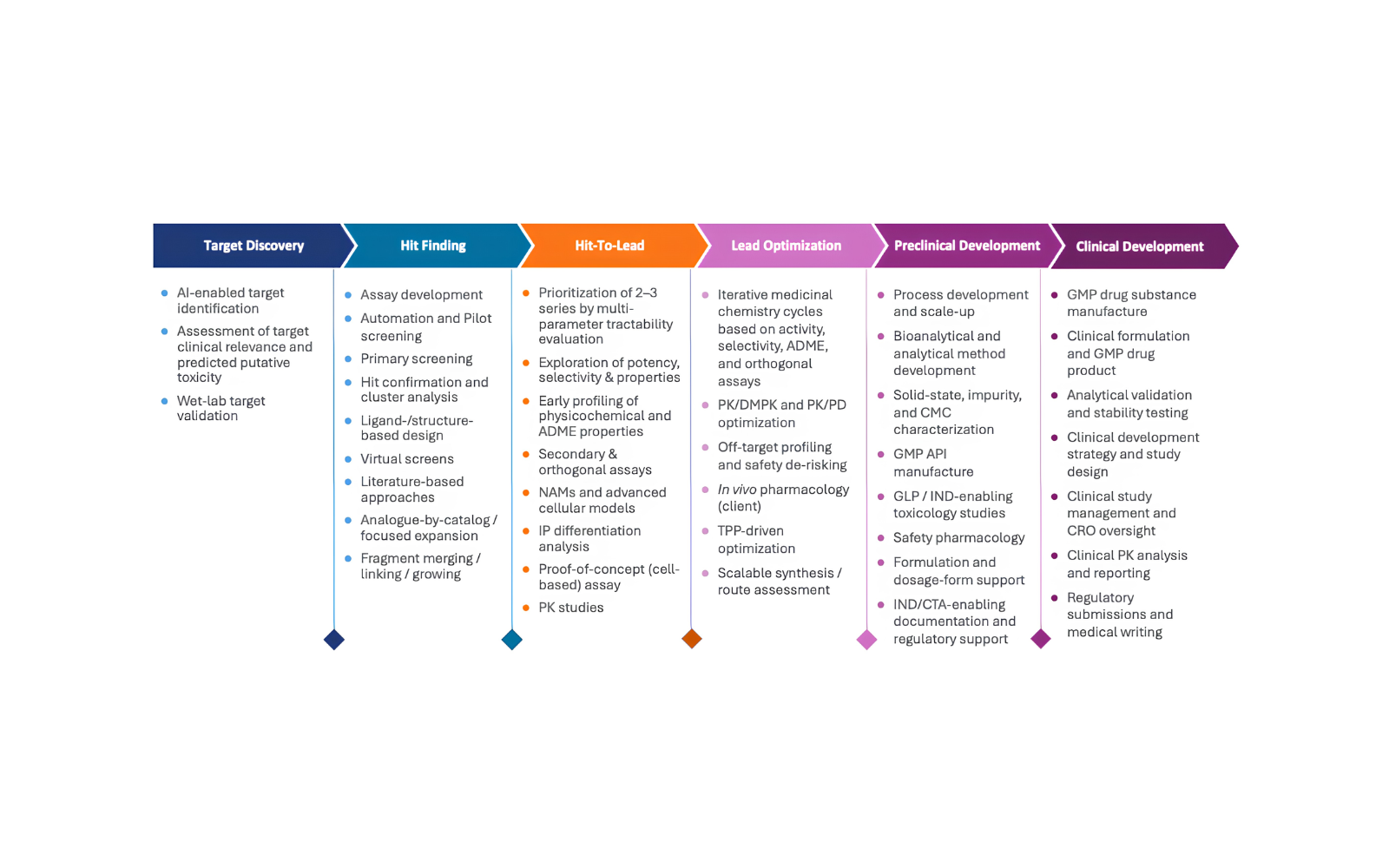
Together, we provide a flexible route from target and hit finding through lead optimization, candidate selection and the path towards IND.
The alliance is built around complementary strengths. Axxam provides a powerful biological engine at the front end of discovery, while Symeres brings chemistry, DMPK and development expertise that remains involved as the program matures.
One program voice. Connected science. Fewer handovers.
Add the Axxam biology
engine
Symeres medicinal chemists routinely work across hit-to-lead and lead optimization, combining SAR, compound design and synthesis with computational chemistry and ADME data.
The alliance substantially extends the biological capabilities available within those programs.
Axxam brings expertise in target assessment and experimental validation, biochemical and cell-based assay development, high-throughput screening, high-content and phenotypic approaches, electrophysiology, advanced cellular models, hit confirmation and orthogonal profiling.
This makes it possible for a program to begin much earlier than a conventional chemistry engagement.
Axxam can help establish the biological hypothesis and identify high-quality starting points; Symeres chemistry can then engage early to assess tractability, explore SAR and determine which hit series justify further investment.
From hit to candidate in one connected
program
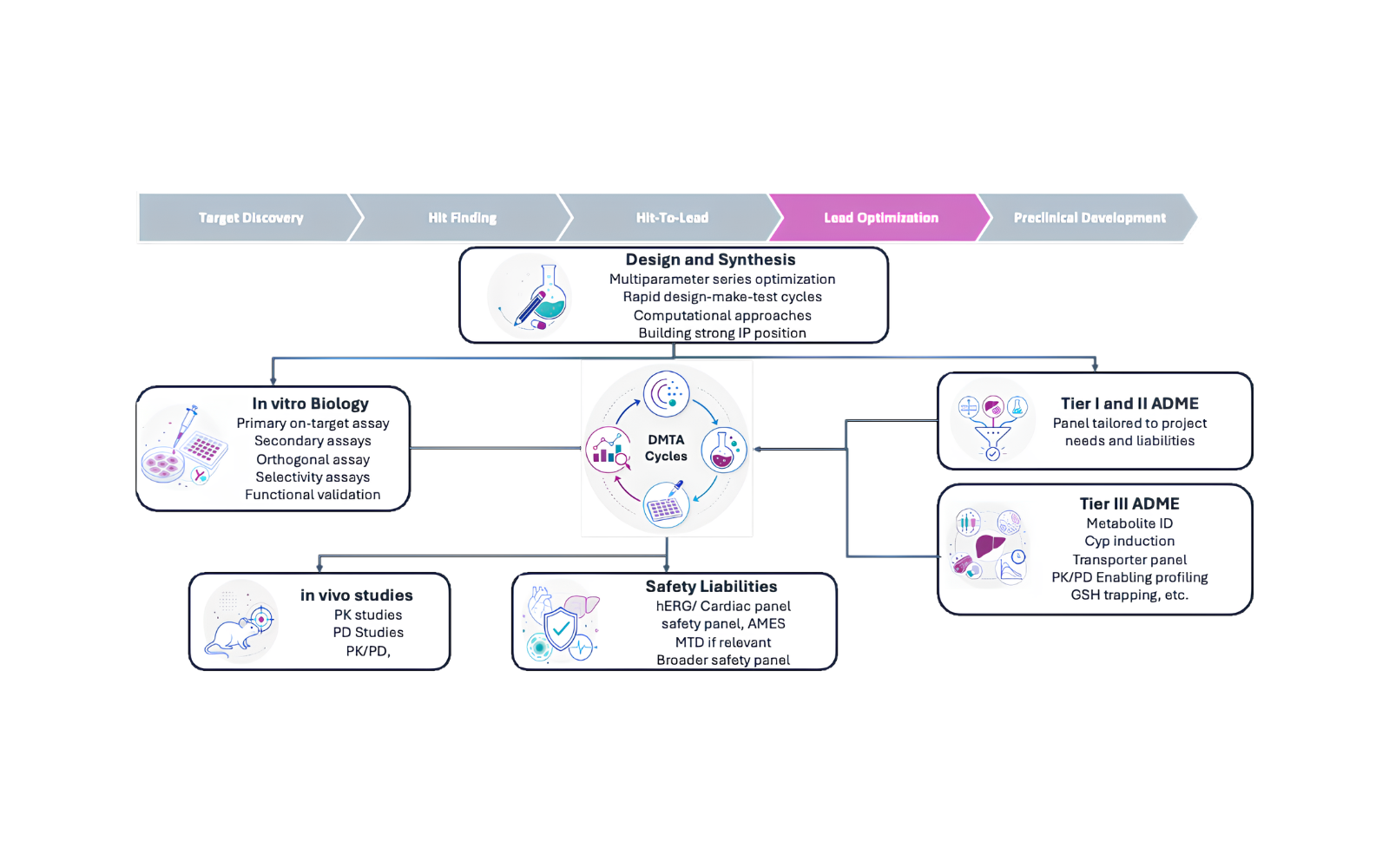
During hit-to-lead, Axxam biology can run alongside Symeres medicinal chemistry and early ADME, allowing potency, selectivity, physicochemical behavior and metabolic properties to inform each new design cycle.
Rather than treating biology, chemistry and DMPK as sequential disciplines, the program can use them together to answer increasingly demanding questions: does the compound engage the target, does the biology translate across assays, can the chemistry be improved, and are the emerging properties compatible with a realistic drug profile?
As programs move into lead optimization, Symeres can add deeper ADME/DMPK through the Admescope platform, together with physicochemical profiling, early safety assessment and PK where appropriate.
For oncology programs, the Oncolines platform can add cancer-cell profiling, biomarker analysis, bioinformatics and biophysical characterization.
The objective is multiparameter optimization towards a stronger candidate, not potency in isolation.
Development thinking before development
begins
One advantage of the Symeres-led perspective is the ability to connect discovery with what comes next.
As candidate quality improves, Symeres can begin assessing route scalability, process safety, solid-state properties, formulation risk and other developability questions while there is still an opportunity to improve the molecule.
Following candidate nomination, the same broader platform can support process R&D, scale-up, analytical development, GMP drug substance, formulation and drug-product activities.
This continuity helps preserve knowledge from discovery and reduces the abrupt handover that can occur when a candidate moves between unrelated discovery and development organizations.
A dedicated PROTAC
platform
The alliance includes a joint Axxam-Symeres PROTAC platform, combining Symeres’ degrader design, linker chemistry, parallel synthesis, medicinal chemistry optimization and ADME/DMPK with Axxam’s binder screening, degradation assays, target-engagement studies and functional biology.
Chemistry and degradation biology can therefore operate in the same learning cycle, with developability considerations introduced as the program matures. For oncology PROTACs, Oncolines adds broad cancer-cell-line profiling, biomarker and mechanism-of-action analysis, while SPR biophysics can support binder characterization and kinetics.
One team around the
program
Integrated projects are designed to minimize the burden of coordinating multiple CROs.
A clear program lead, direct scientist-to-scientist communication, shared milestones and connected data keep biology, chemistry and DMPK aligned around the next decision. Engagement can begin with a standalone project and expand as scientific needs evolve, using fee-for-service, dedicated-team or blended models as appropriate.
Axxam and Symeres have already executed multiple projects together, including programs spanning assay development, screening, medicinal chemistry, lead optimization and subsequent development activities.
The alliance is therefore not simply an expanded list of services. It is a central part of how Symeres is extending its discovery offering: deep chemistry and development expertise connected with the biological capabilities needed to make better decisions earlier.
Start at the point your program has reached. Bring in the disciplines it needs next. Keep the science connected as the candidate progresses.
Your transatlantic drug development partner
Symeres support small-molecule programs from discovery through IND with openness, agility and scientific depth. Our connected teams in Europe and North America provide medicinal chemistry, computational chemistry, synthetic chemistry, and specialty chemistry services integrated with biology, ADME-tox, and CMC development.
We share data transparently, adapt quickly to new results, and stay accountable from first experiments to IND, to keep your progress clear, connected and continuous. Projects can run as standalone studies or as coordinated, multi-disciplinary programs.





What Large Cell Panel Profiling Reveals About Your ADC
DILI uncovered: from animal models to a weight-of-evidence future